

Ever have these thoughts go through your head when thinking about having a hard conversation?
“They won’t listen.”
“They’ll just get defensive.”
Or “this will backfire on me.”
It could be at work, where maybe your coworker keeps leaving early, and you’re stuck picking up the slack. Or maybe it’s at home, where the credit card balance keeps creeping up, and it’s stressing you out because it’s on you to pay it off.
You rehearse the conversation in your head a hundred times. You imagine the words you are going to say.
Then you predict their reaction…and then ultimately, for a good portion of us, we land on “not today”. And we kick that can down the road.
Every one of us deals with opportunities for hard conversations.
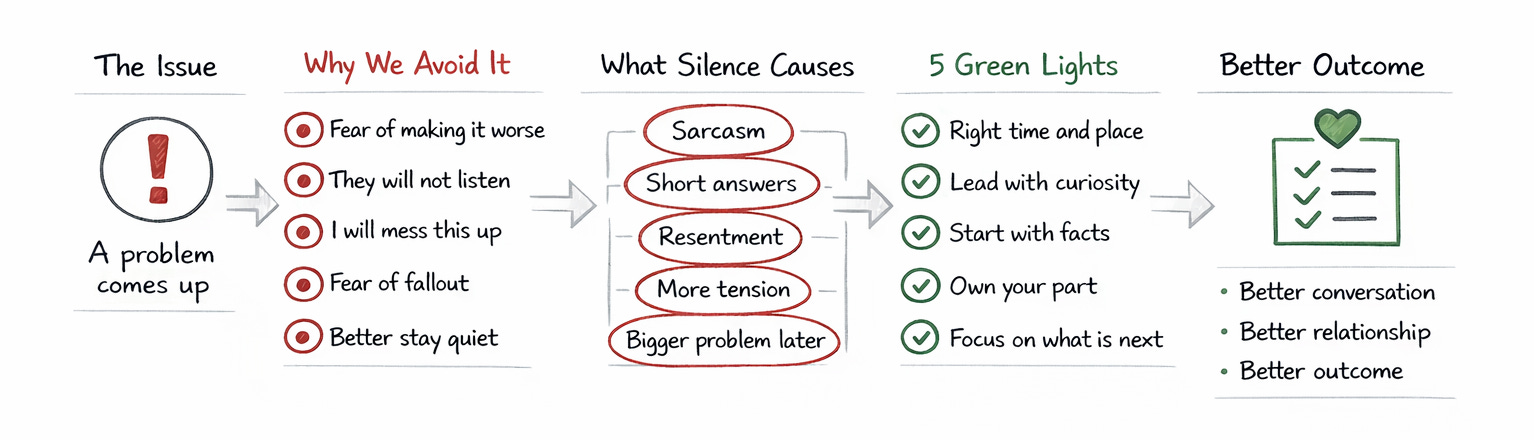
And most of us avoid them for 5 common reasons.
Fear of making it worse. You think speaking up will only stir the pot.
Doubt they’ll listen. You’ve tried before, and nothing has changed.
Worry you’ll mess it up. You don’t want to sound too harsh or too soft.
Fear of fallout. You don’t know what will happen next, and that unforeseen future keeps you quiet.
Taught to stay silent. Somewhere back in time, you learned that honesty equals disrespect, so you just shut your mouth and go with the flow.
Avoiding the conversation can feel safer in the moment. But your silence can come back to bite you.
You may find yourself being
sarcastic
giving short answers, or
being resentful towards the person.
The conversations that no one wants to have usually cause the most damage when they’re not had.
So… how do you get better at this?
I have five practical tips that you can use.
Pick the right time and place. Don’t bring it up when emotions are high or time is short. Don’t do it in front of others in the break room or at a family gathering. You know, privacy and timing matter way more than people think.
Lead with curiosity. Go in like there’s something you don’t know. You never know what’s going on in the other person’s life, or maybe they never thought about it as you did.
Start with facts. Stick to what you’ve seen or heard, but not what you think it means. People are more open when you describe the facts of the situation and not assumptions.
Own your part. If you’ve waited too long or added to the tension of the situation, say that. It builds trust when you’re not just pointing fingers at the other person.
Focus on what’s next. Don’t just talk about the problem. End with what needs to change, and what both of you can do going forward.
Don’t expect these conversations to be perfect. They won’t be.
And don’t expect to be fearless initially. Just take a small step and have the first one. Get it out of the way.
With practice, you will no longer be intimidated by difficult conversations.
Here’s the summary.
You got this!
-Lance
Want to help your team build confidence and take stronger action?
